
Double-gang format
Matches the corresponding faceplate format for a complete surface-mounted outlet.
Available options
Choose the gang format and depth required for the installation.
At a glance
This white ABS surface backbox provides the enclosure behind a compatible modular faceplate, giving the outlet a defined mounting depth without requiring a recessed wall box.
Matches the corresponding faceplate format for a complete surface-mounted outlet.
Gives the fitted modules and cable termination working room behind the faceplate.
Matches compatible faceplates using the same fixing-centre spacing.
Dimensional data
Proportional dimensional drawing generated from the stored component measurements.
Rear fixing-centre spacing is measured; the vertical position of the fixing datum pair is schematic.
Schematic dimensional outline generated from product data. Undimensioned component geometry is illustrative and the drawing is not intended for fabrication.
Technical data
Complete the outlet
Compatible components and complete outlet configurations for this surface backbox.
Faceplates
Faceplates actually paired with this backbox in complete outlet assemblies.
Complete outlets
Complete outlet kits that contain this exact surface backbox according to the product BOM.
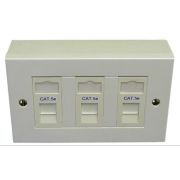 Cat5e 3-Way Data Outlet Kit with Backbox
£4.94
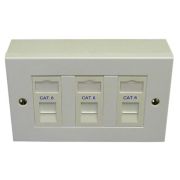 Cat6 3-Way Data Outlet Kit with Backbox
£5.24
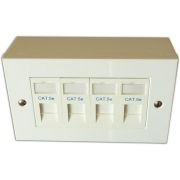 Cat5e 4-Way Data Outlet Kit with Backbox
£5.79
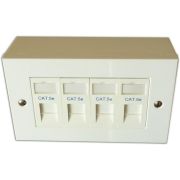 Cat6 4-Way Data Outlet Kit with Backbox
£5.94
Data modules
Data modules used in complete outlet assemblies built with this backbox.
Blanking
Blanking component used in partially populated outlet assemblies built with this backbox.
Reviews are shared across closely related product variants, so you can benefit from relevant experience across the range.
Installed CAT6 from upstairs to living room router, the CAT6 box was easy to install and makes it look like a professional had installed the box.
Good quality and value
Will buy again
Does what you want it do
Thank you
Flimsy rubbish and so over priced compared to cheaper and more superior products.
easy to fit
Arrived 1 day late, given the current circumstances thats pretty good. Used for extending ethernet in house
This solid Double 13a box allows room for Cables inside to be connected safely. It is easily secured to the wall with Screws. This should be carried out by a Qualified Electrician. Will buy same again online.
Does the job
Has a 32mm depth but did not fit my 25mm socket the problem is the fitting posts, they are flush and do not allow for the socket fitting!
The 'weak link' cut outs dont break off and you end up with jarred edges. You then have to find a files and cutters to try and fix what should have been a simple snap off operation. If you are happy with all that then it might be cheap but Id recommend buying something different or better for not much more and save all the hassle and not having to worry that you will damage cables pulling through sharp edges
Be the first to review 32 mm Double-Gang White Surface Backbox.
Your review will help other customers considering this exact product.
Helpful information gathered across closely related product variants.
Browse Surface Backboxes helpIt provides a box behind a faceplate when the outlet is being mounted on the surface of a wall rather than onto a recessed box. It gives the modules and cable somewhere to live while providing the fixing points for the faceplate.
It is a fairly prosaic component, but without it a surface-mounted outlet would otherwise have its workings hanging rather inelegantly in the open.
The 21mm version is single-gang and measures 85.5 × 85.5 × 21mm overall. The 32mm version is double-gang and measures 145.5 × 85.5 × 32mm.
The single-gang box is used with our 1- and 2-way outlet kits, while the double-gang box is used with the 3- and 4-way versions.
Yes. The single-gang box uses standard 60.3mm faceplate fixing centres and the double-gang box uses 120.6mm centres. Compatible standard UK single- and double-gang faceplates will therefore fit mechanically.
Use suitable screws through the fixing slots in the rear of the box. Choose the screws and wall plugs for the surface you are fixing into, get the box level, then tighten it securely without distorting the plastic.
There are cable-entry provisions at the rear and around the perimeter of the box, so the cable can approach from several directions.
You are not obliged to march every cable through the middle simply because the large rear knockout is the most conspicuous opening. Use the entry that gives the cable the cleanest route to the fitted module without forcing an unnecessary bend.
No. Use the rear knockout if the cable is coming through the wall behind the box, or use one of the perimeter cutouts when the cable approaches along the wall. Pick the entry that gives the cable the easiest route.
It provides a box behind a faceplate when the outlet is being mounted on the surface of a wall rather than onto a recessed box. It gives the modules and cable somewhere to live while providing the fixing points for the faceplate.
It is a fairly prosaic component, but without it a surface-mounted outlet would otherwise have its workings hanging rather inelegantly in the open.
The 21mm version is single-gang and measures 85.5 × 85.5 × 21mm overall. The 32mm version is double-gang and measures 145.5 × 85.5 × 32mm.
The single-gang box is used with our 1- and 2-way outlet kits, while the double-gang box is used with the 3- and 4-way versions.
Yes. The 21mm single-gang backbox is the same box supplied with our 1- and 2-way surface-mount outlet kits, and the 32mm double-gang version is the same box used with the 3- and 4-way kits.
We supply and specify these boxes for data and other suitable low-voltage outlets rather than as mains-accessory backboxes. A standard UK accessory may be mechanically similar, but mechanical fit is only one part of the story.
For mains wiring, use a backbox and accessory system specifically intended and approved for that application.
Yes. The single-gang box uses standard 60.3mm faceplate fixing centres and the double-gang box uses 120.6mm centres. Compatible standard UK single- and double-gang faceplates will therefore fit mechanically.
Use suitable screws through the fixing slots in the rear of the box. Choose the screws and wall plugs for the surface you are fixing into, get the box level, then tighten it securely without distorting the plastic.
No. Wall screws and plugs are not supplied because the correct fixing depends on what you are mounting the box to. Use fixings suitable for the wall material.
No. It can be mounted in whichever orientation suits the installation. Horizontal is the normal arrangement, but there are plenty of cable-entry options around the box, so there is no need to rotate it simply to get the cable in.
There are cable-entry provisions at the rear and around the perimeter of the box, so the cable can approach from several directions.
You are not obliged to march every cable through the middle simply because the large rear knockout is the most conspicuous opening. Use the entry that gives the cable the cleanest route to the fitted module without forcing an unnecessary bend.
No. Use the rear knockout if the cable is coming through the wall behind the box, or use one of the perimeter cutouts when the cable approaches along the wall. Pick the entry that gives the cable the easiest route.
On the 21mm single-gang box, the measured rear knockout area is approximately 25 × 45mm. On the 32mm double-gang box it is approximately 26 × 31mm. These are dimensions of the removable rear entry, not maximum cable-size ratings.
The 21mm single-gang box provides approximately 18.5mm of usable internal depth. The 32mm double-gang box provides approximately 30mm.
Internal width, fixing bosses, the fitted modules and cable route also affect how much practical working room is available.
No. Those figures are the overall external depths of the boxes. The corresponding measured usable internal depths are approximately 18.5mm and 30mm.
Walls and internal mouldings inevitably consume some of the nominal depth; a plastic box has not yet discovered the trick of being thinner on the inside than the outside.
Yes, if the installation allows it.
The 21mm and 32mm boxes are the normal surface-box arrangements we use, but there is no prize for squeezing a stiff cable into the shallowest possible space. If the cable or module is being forced into a sharp bend, a deeper compatible backbox gives you more room to dress the cable naturally and usually makes the whole installation less of a wrestling match.