Cat5e
Network category
Structured Ethernet category.
Available options
Choose the required network category.
At a glance
Cat5e
Structured Ethernet category.
IDC punchdown
Connection method provided by the coupler.
Solid installation cable
Cable construction intended for termination.
Krone / 110
Compatible punchdown termination standards.
Free-standing
Internal
26 × 24.7 × 62.29 mm
Overall dimensions for installation planning.
This Cat5e IDC inline coupler is designed for joining or extending two four-pair solid installation cables as part of a permanent cabling run. Each cable terminates directly onto colour-coded IDC contacts rather than first being fitted with an RJ45 plug.
Krone-style termination is recommended, while the IDC contacts are compatible with Krone and 110 termination tooling. The compact unshielded ABS enclosure is intended for internal installations and can be accommodated inside trunking in many applications.
Designed for joining permanent installation cable rather than terminated patch leads.
IDC contacts can be terminated with compatible Krone or 110 tooling.
Compact enclosed joint for internal structured-cabling installations.
Technical data
Complete the installation
Compatible products and installation guidance for this IDC coupler.
Permanent link
Join or extend matching-category solid installation cable using this IDC coupler.
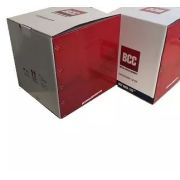 Cat5e U/UTP LSZH Installation Cable – Violet – 305m
£99.99
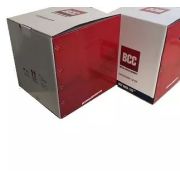 Cat5e U/UTP LSZH Cca Installation Cable – Green – 305m
£124.99
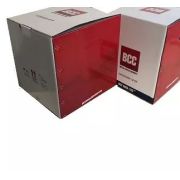 Cat5e U/UTP PE External Installation Cable – Black – 305m
£106.99
Outlet end
Complete the room end of the same permanent-link installation with matching data outlets.
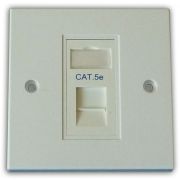 Cat5e 1-Way Data Outlet Kit
£1.99
 Cat5e 2-Way Data Outlet Kit
£2.74
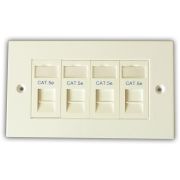 Cat5e 4-Way Data Outlet Kit
£5.49
Cabinet end
Complete the cabinet end of the permanent link with a matching-category patch panel.
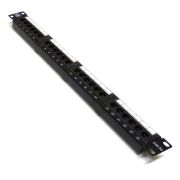 19" 1U 24 Port Cat5e Patch Panel
£24.47
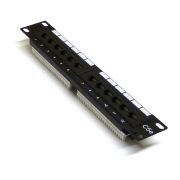 10" 1U 12 Port Cat5e Patch Panel
£18.71
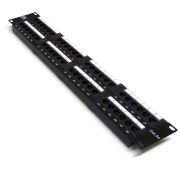 19" 2U 48 Port Cat5e Patch Panel
£35.99
Termination
Use the matching termination tool for reliable IDC punchdown connections.
Reviews are shared across closely related product variants, so you can benefit from relevant experience across the range.
Be the first to write a review of this product.
Helpful information gathered across closely related product variants.
Browse IDC Inline Couplers helpIt joins two four-pair installation cables directly through IDC terminals without having to fit RJ45 plugs.
It is useful for extending a cable, repairing a damaged run or making a permanent inline joint where replacing the complete cable is impractical.
They are physically the same size and use the same general construction and termination method.
Choose the version that matches the category of the cabling system: Cat5e for Cat5e and Cat6 for Cat6.
Yes. Cut back to sound cable, terminate the two ends onto the IDC contacts and close the housing.
If the cable forms part of a structured-cabling link, test the completed link afterwards rather than assuming a tidy-looking repair necessarily preserves its original performance.
Yes. That is one of its main uses.
Terminate the existing cable on one side and the extension cable on the other, keeping the same wiring scheme throughout.
Yes. It can be used as a permanent join where replacing the complete cable would be disproportionate or impractical.
A continuous unbroken cable is still the simpler arrangement when you have that option, but sometimes buildings decline to cooperate.
Keep the joint accessible where practical and test the completed link if its specified cabling performance matters.
Yes. Both T568A and T568B colour codes are marked on the coupler. Choose the wiring scheme used by the installation and follow the corresponding colour code.
It joins two four-pair installation cables directly through IDC terminals without having to fit RJ45 plugs.
It is useful for extending a cable, repairing a damaged run or making a permanent inline joint where replacing the complete cable is impractical.
They are physically the same size and use the same general construction and termination method.
Choose the version that matches the category of the cabling system: Cat5e for Cat5e and Cat6 for Cat6.
No. These are unshielded couplers in an ABS housing.
They are intended for unshielded structured-cabling installations rather than maintaining a screened or shielded cable path.
Yes. Cut back to sound cable, terminate the two ends onto the IDC contacts and close the housing.
If the cable forms part of a structured-cabling link, test the completed link afterwards rather than assuming a tidy-looking repair necessarily preserves its original performance.
Yes. That is one of its main uses.
Terminate the existing cable on one side and the extension cable on the other, keeping the same wiring scheme throughout.
Yes. It can be used as a permanent join where replacing the complete cable would be disproportionate or impractical.
A continuous unbroken cable is still the simpler arrangement when you have that option, but sometimes buildings decline to cooperate.
Keep the joint accessible where practical and test the completed link if its specified cabling performance matters.
Yes. Both T568A and T568B colour codes are marked on the coupler. Choose the wiring scheme used by the installation and follow the corresponding colour code.
Yes. Terminate both cable ends to the same scheme: A to A or B to B. Do not change from T568A to T568B halfway through the connection.
It is straight through. Each conductor position on one side continues to the corresponding position on the other; the coupler is not intended to create a crossover connection.
No. The cable conductors terminate directly onto the IDC contacts, which is the point of this type of coupler. There are no RJ45 plugs or sockets involved.
A Krone-style punchdown tool is recommended. The IDC terminals are compatible with Krone and 110 termination tooling.
These couplers are specified for solid installation cable.
We do not currently publish a stranded-conductor specification for them, so use solid cable rather than assuming that a particular stranded patch cable will terminate reliably.
Each cable entry has a strain-relief feature, and two cable ties are supplied so the cables can be secured after termination. Once the conductors have been punched down, the outer housing screws together to form a protective shell around the IDC connections.
The restraints should act on the cable jacket rather than leaving the individual conductors to take any pull.
Yes. Two cable ties are supplied with both the Cat5e and Cat6 couplers, one for each cable entry.
Yes, they can be reterminated, but we do not publish a specific retermination-cycle figure for these couplers.
If an IDC contact has become damaged or no longer grips the conductor positively, replace the coupler rather than repeatedly reusing a questionable termination.
Yes. Its compact enclosed construction makes trunking a useful location where there is enough room to dress the cables without forcing a sharp bend.
For a permanent joint, we recommend keeping the coupler accessible through a removable trunking cover rather than permanently burying it.
We do not currently publish a product-specific PoE, PoE+ or PoE++ rating for these couplers. We therefore would not infer a particular PoE capability simply from the Cat5e or Cat6 category.