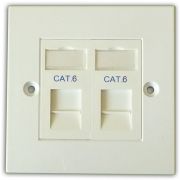
2 module positions
Populate the available positions with compatible data modules or blanking components to suit the installation.
Available options
Choose the number of 25 × 50 mm module positions required.
At a glance
This white ABS faceplate provides two positions for compatible 25 × 50 mm inserts, creating a neat finished mounting point for a modular data outlet.
Populate the available positions with compatible data modules or blanking components to suit the installation.
Uses a consistent modular aperture format so matching inserts can be selected separately.
Matches compatible flush or surface boxes using the same fixing-centre spacing.
In the box
Faceplate mounting screws supplied with this component.
Dimensional data
Proportional dimensional drawing generated from the stored component measurements.
Fixing-hole horizontal position is derived symmetrically from the measured overall width and fixing-centre spacing.
Schematic dimensional outline generated from product data. Undimensioned component geometry is illustrative and the drawing is not intended for fabrication.
Technical data
Complete the outlet
Compatible components and complete outlet configurations for this faceplate.
Data modules
Data modules actually used with this faceplate in complete outlet assemblies.
Complete outlets
Complete outlet kits that contain this exact faceplate according to the product BOM.
View complete outlet kitsBlanking
Blanking component used with this faceplate in partially populated outlet assemblies.
Surface mounting
Surface backbox actually paired with this faceplate in complete outlet kits.
Reviews are shared across closely related product variants, so you can benefit from relevant experience across the range.
5 star
Be the first to review White Faceplate for 2 × 25 × 50 mm Modules.
Your review will help other customers considering this exact product.
Helpful information gathered across closely related product variants.
Browse Data Faceplates helpIt is the mounting frame for interchangeable Euro-style low-voltage modules. The faceplate provides the mechanical opening and wall fixing; the module you clip into it provides the actual network, telephone, AV or other function.
In other words, the plate is the stage rather than the performer.
Neither. The same faceplate can be used with Cat5e or Cat6 modules.
Network category belongs to the fitted module and the rest of the cabling system; changing the piece of white plastic around it cannot promote the network to a different category.
FP1 provides one 25 × 50mm module position. FP2 has a continuous 50 × 50mm opening, so it can take two 25 × 50mm modules or a compatible 50 × 50mm module. FP4 has a continuous 100 × 50mm opening for four 25 × 50mm positions, two 50 × 50mm modules or other compatible Euro-module arrangements.
12.5 × 50mm blanks and spacers can also be used where required.
Yes, provided they use the compatible Euro-module format. The faceplates are not restricted to DCD RJ45 inserts.
Euro compatibility describes the mechanical format, though, so the electrical or signal suitability of whatever you fit remains a property of that module rather than the plate.
Yes. Compatible 12.5 × 50mm blanks and spacers can be used to fill part of the modular opening.
They are also how the 4-position plate can be arranged neatly around three 25 × 50mm modules.
No. FP2 has one continuous 50 × 50mm modular opening and FP4 has one continuous 100 × 50mm opening.
The 25 × 50mm positions shown in the specification describe their normal module capacity rather than separate holes moulded into the faceplate.
It is the mounting frame for interchangeable Euro-style low-voltage modules. The faceplate provides the mechanical opening and wall fixing; the module you clip into it provides the actual network, telephone, AV or other function.
In other words, the plate is the stage rather than the performer.
Neither. The same faceplate can be used with Cat5e or Cat6 modules.
Network category belongs to the fitted module and the rest of the cabling system; changing the piece of white plastic around it cannot promote the network to a different category.
They are white ABS faceplates with a gloss finish. They are intended for indoor use.
No. The faceplate is only the mechanical mounting frame and does not sit in the copper signal or power path.
PoE capability depends on the fitted module, cabling and connected equipment rather than the faceplate surrounding the socket.
FP1 provides one 25 × 50mm module position. FP2 has a continuous 50 × 50mm opening, so it can take two 25 × 50mm modules or a compatible 50 × 50mm module. FP4 has a continuous 100 × 50mm opening for four 25 × 50mm positions, two 50 × 50mm modules or other compatible Euro-module arrangements.
12.5 × 50mm blanks and spacers can also be used where required.
Yes, provided they use the compatible Euro-module format. The faceplates are not restricted to DCD RJ45 inserts.
Euro compatibility describes the mechanical format, though, so the electrical or signal suitability of whatever you fit remains a property of that module rather than the plate.
Yes. Compatible 12.5 × 50mm blanks and spacers can be used to fill part of the modular opening.
They are also how the 4-position plate can be arranged neatly around three 25 × 50mm modules.
No. FP2 has one continuous 50 × 50mm modular opening and FP4 has one continuous 100 × 50mm opening.
The 25 × 50mm positions shown in the specification describe their normal module capacity rather than separate holes moulded into the faceplate.
Use FP1 for one module and FP2 for two.
FP4 is used for four modules, and it is also the plate used for a three-module arrangement with blank spacers taking up the remaining width. There is no separate FP3 moulding hiding somewhere in the range.
Yes. Fit the module into the modular opening from the front until it clips into place.
The DCD RJ45 modules are released from the rear, so remove the faceplate from the wall before unclipping one for replacement.
Yes in FP2 or FP4. FP2 has a 50mm-wide continuous opening and FP4 has a 100mm-wide opening. FP1 only has space for a single 25 × 50mm module.
No. A three-module outlet uses FP4. Three 25 × 50mm modules occupy 75mm of its 100mm opening, and two 12.5 × 50mm spacers fill the remaining 25mm to produce the centred three-module arrangement.
Yes. Each RJ45 module clips into the faceplate independently.
With the DCD modules, remove the faceplate from the wall first, then unclip the required module by hand from the rear of the assembly. Some other Euro modules may provide front-release mechanisms, but the DCD RJ45 modules are intended to be released from behind.
Yes. Remove the faceplate from the wall, unclip the damaged module from the rear and replace that module only. The neighbouring modules and the faceplate do not need to be replaced simply because one socket has failed.
Yes, provided the other insert uses the compatible Euro-module format.
An RJ45 module can sit beside blanks or other suitable Euro modules, which is one of the useful peculiarities of the system: the faceplate can be assembled for the room rather than every aperture having to do the same job.
Yes, provided the insert is a mechanically compatible low-voltage Euro module.
The useful point of the system is that the plate does not particularly care whether the aperture contains RJ45, telephone, coax, HDMI or another suitable low-voltage service; the fitted module determines what that position actually does.
We specify these faceplates for compatible low-voltage Euro modules and do not make a mains-accessory suitability claim for them.
For mains wiring, use an accessory system specifically designed and approved for that application.
A mechanically compatible shielded Euro module can be fitted, but the ABS faceplate itself provides no screen bonding or earth path.
Any required shielding continuity must therefore be provided by the module and the rest of the cabling system.
Yes. FP1 and FP2 are standard single-gang size with 60.3mm fixing centres. FP4 is double-gang with 120.6mm fixing centres.
They can be used with compatible UK flush or surface backboxes.
No. The faceplate itself can be mounted either way up. Orient the modules as required for the finished outlet.
Yes. Two standard M3.5 faceplate screws are supplied.
Yes. The 1- and 2-way faceplates use standard single-gang fixing centres of approximately 60.3mm; the 3- and 4-way versions use the corresponding double-gang format.
The backbox still needs enough depth for the module and cable.
Yes. A deeper compatible backbox is perfectly acceptable and often makes cable dressing rather more civilised, particularly with stiff installation cable.
There is no benefit in squeezing a nest of conductors into the shallowest possible box when the wall gives you more room.