Cat6
Network category
Structured Ethernet cable category.
Available options
Choose an option to view the corresponding patch lead.
At a glance
Cat6
Structured Ethernet cable category.
U/UTP
Cable shielding construction.
Bare copper
24 AWG, 4 pairs
250 MHz
Rated cable transmission frequency.
RJ45 ↔ RJ45
Moulded connectors
PU jacket
Key technical product information.
Pre-terminated with moulded RJ45 connectors at both ends, this U/UTP lead uses 24 AWG bare copper conductors and a PU jacket for network runs requiring an external-use cable.
Designed for Cat6 Ethernet patching between compatible network ports.
Polyurethane outer jacket for network runs requiring an external-use cable.
Ready terminated at both ends, so no field termination is required.
Technical data
Complete the connection
Matching connection points and inline accessories for this Cat6 patch lead.
Cat6 patch leads are backward compatible with Cat5e equipment. Overall connection performance is limited by the lowest-rated component.
Outlet end
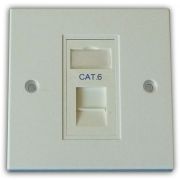
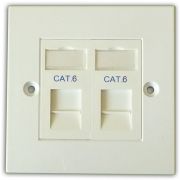
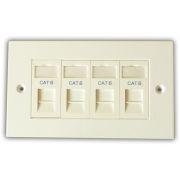
Connect this patch lead to a matching-category RJ45 data outlet.
View outlet kitsCabinet end
Use with a matching-category patch panel at the rack or cabinet end.
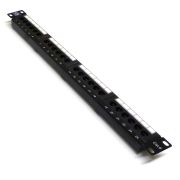 19" 1U 24 Port Cat6 Patch Panel
£30.47
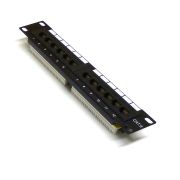 10" 1U 12 Port Cat6 Patch Panel
£24.71
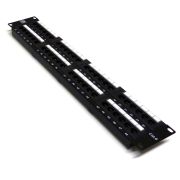 19" 2U 48 Port Cat6 Patch Panel
£41.99
Inline connection
Join two RJ45 patch leads without cutting or reterminating either cable.
View network couplersReviews are shared across closely related product variants, so you can benefit from relevant experience across the range.
Be the first to write a review of this product.
Helpful information gathered across closely related product variants.
Browse Cat6 Patch Leads helpIt is a standard RJ45 Ethernet patch lead for flexible equipment connections: switch to patch panel, wall outlet to device, router to switch, or directly between ordinary Ethernet equipment.
It is the movable cord at the ends of a cabling channel rather than the fixed cable normally installed through a building.
Yes. Cat6 is backwards compatible with Cat5e Ethernet equipment and cabling.
The completed connection will perform according to the lowest-rated component in the channel.
Yes. These leads use Cat6 U/UTP, 24AWG stranded bare-copper cable rated to 250MHz with moulded RJ45 plugs.
The standard range also has third-party verification recorded in the catalogue; the external versions use the same basic electrical construction with a PE outer jacket.
The familiar 100m figure is for the complete copper channel, not for each individual cable in it.
A conventional structured channel is based around up to 90m of permanent-link cabling plus the patch and equipment cords.
Long stranded patch cords also have greater insertion loss than solid horizontal cable, so the neat 90-plus-10 picture should not be treated as a licence to assemble any collection of cords that happens to total 100m.
For the variants up to and including 30m, the catalogue records support for PoE Types 1, 2, 3 and 4.
The powered device, power-sourcing equipment and the rest of the cabling channel must also support the required PoE type.
Yes on the patch-lead variants up to 30m: the catalogue records support through PoE Type 4.
We do not extend that positive product claim to the longer patch leads.
It is a standard RJ45 Ethernet patch lead for flexible equipment connections: switch to patch panel, wall outlet to device, router to switch, or directly between ordinary Ethernet equipment.
It is the movable cord at the ends of a cabling channel rather than the fixed cable normally installed through a building.
Yes. Cat6 is backwards compatible with Cat5e Ethernet equipment and cabling.
The completed connection will perform according to the lowest-rated component in the channel.
Yes. That is one of the jobs a stranded patch lead is made for.
Choose a length that reaches comfortably without leaving a heap of unnecessary slack in the rack.
Yes, the RJ45 connection is compatible, but this particular lead remains Cat6.
Putting a Cat6 cord into an otherwise Cat6A channel does not somehow promote the cord to Cat6A; the channel should be judged by its lowest-category component.
Yes. If both devices have normal RJ45 Ethernet ports, plug one end into the router or switch and the other into the computer.
Yes, provided the device has an RJ45 Ethernet port. The lead is not tied to a particular type of network device.
Normally, no. Modern Ethernet equipment generally supports Auto MDI-X, so an ordinary straight-through patch lead is used even between switches.
Crossover leads are now mostly a concern with much older equipment.
No. Categories can interoperate, so a Cat6 lead can be used with Cat5e equipment or cabling.
What you do not get is Cat6 performance by sprinkling one Cat6 component into an otherwise lower-category channel; the weakest component still sets the useful ceiling.
Yes, use a properly rated RJ45 coupler.
It adds another connection to the channel, so a single lead of the right length is preferable where practical, and the total channel length still matters.
Yes. These leads use Cat6 U/UTP, 24AWG stranded bare-copper cable rated to 250MHz with moulded RJ45 plugs.
The standard range also has third-party verification recorded in the catalogue; the external versions use the same basic electrical construction with a PE outer jacket.
Yes. Gigabit Ethernet is within the normal capability of a Cat6 channel, provided the rest of the cabling and equipment are suitable.
Cat6 can carry 10GBASE-T over suitably short, well-performing channels, but that is not a blanket promise that any long Cat6 patch lead will deliver 10 Gigabit.
Channel length, connectors, installation and alien crosstalk all matter.
Where 10 Gigabit is required across a full 100m structured channel, Cat6A is the more appropriate design choice.
No intentional electrical difference is specified.
The external versions use the same basic Cat6 patch-lead construction; the important change is the PE outer jacket for outdoor/exposed routing.
Cat6 is suitable for those multi-gigabit Ethernet rates in normal compliant cabling channels.
The actual negotiated speed still depends on both pieces of active equipment and the condition and length of the complete link.
Not by itself. If your router, switch, device and existing cabling are already handling the required speed, changing one patch lead will not increase the broadband service you receive.
It is the specified transmission-frequency range of the Cat6 cable, not the speed of your internet connection and not a processor-style clock rate.
Network data rate depends on the Ethernet standard and the performance of the whole channel.
Not for an ordinary unshielded Cat6 installation. U/UTP relies on the geometry and twisting of the four pairs rather than foil or braid.
In an environment with unusually severe electromagnetic interference, a properly designed shielded cabling system may be more appropriate.
The familiar 100m figure is for the complete copper channel, not for each individual cable in it.
A conventional structured channel is based around up to 90m of permanent-link cabling plus the patch and equipment cords.
Long stranded patch cords also have greater insertion loss than solid horizontal cable, so the neat 90-plus-10 picture should not be treated as a licence to assemble any collection of cords that happens to total 100m.
Because cable assemblies are used in more than one kind of installation, but the existence of a 100m cord does not rewrite structured-cabling rules.
As an Ethernet channel, a 100m patch cord by itself reaches the familiar nominal channel distance before any extra patching is added, and its stranded construction can require additional allowance.
For a standards-critical 100m copper installation, design and test the complete channel rather than treating the number on the packet as a guarantee.
No, not as the normal choice.
Use solid installation cable for the fixed run and stranded patch leads at the ends. That gives you a more conventional structured-cabling installation and keeps the flexible cord where its flexibility is actually useful.
Not at these distances in any way you would normally notice.
The practical concern with long copper cabling is meeting the channel's electrical performance limits, not a perceptible pause caused by a few extra metres of propagation time.
Yes. A little service slack is useful.
Keep any spare length in a loose loop rather than crushing it into a tight coil or putting a sharp bend next to the plug; the bigger problem with excessive spare cable is usually the resulting tangle.
You can use suitable couplers, but don't build a labyrinth of joins unless you have to.
Every coupler adds another connection and the entire run still has to stay within the channel's performance limits.
One correctly sized lead is the cleaner solution.
For the variants up to and including 30m, the catalogue records support for PoE Types 1, 2, 3 and 4.
The powered device, power-sourcing equipment and the rest of the cabling channel must also support the required PoE type.
Yes on the patch-lead variants up to 30m: the catalogue records support through PoE Type 4.
We do not extend that positive product claim to the longer patch leads.
Yes on the lengths for which PoE support is specified, provided the switch or injector supplies the PoE type the device needs and the rest of the channel is suitable.
The external lead uses the same basic Cat6 construction, and the positive PoE claim applies to external variants up to 30m as well.
Protect the RJ45 connection from the weather and make sure the complete PoE channel is suitable for the device.
Yes. Copper resistance increases with length, so some voltage is lost in the cable and some power is dissipated as heat.
That is why PoE design becomes more important as cable length, current and bundle size increase.
It is specified as bare copper, not copper-clad aluminium.
They are 24AWG stranded conductors.
Because a patch lead lives a more itinerant life than the cable buried in a wall.
It gets routed through managers, moved between ports and bent whenever equipment changes.
Stranded conductors tolerate that repeated flexing better; solid conductors are normally preferred for the fixed permanent link because they have lower loss and do not need the same flexibility.
Yes. These are RJ45-to-RJ45 male patch leads with moulded terminations.
The normal specification uses a conventional exposed RJ45 latch.
We have occasionally received snagless-style cables in error from the supplier, so I would not promise one exact boot shape across every item physically on the shelf.
If the latch style matters for your installation, ask us and we can check the current stock.
AWG is the conductor gauge.
These leads use 24AWG stranded conductors, a conventional full-size patch-cord construction rather than the much thinner conductors used in some high-density slim cords.
Correct. U/UTP means the cable has unshielded twisted pairs and no overall metallic screen.
You can reterminate stranded Ethernet cable with a plug designed for the conductor type, but the moulded plug you cut off is not reusable.
On a ready-made patch lead it is normally cleaner to use the right length in the first place or replace a damaged lead.
Start by swapping in a known-good lead and checking both Ethernet ports.
Gigabit Ethernet uses all four pairs, so damage or a bad contact affecting one pair can leave some equipment falling back to 100Mbps.
A simple visual check is not enough to rule that out.
No. A basic continuity tester is useful for finding opens, shorts and wiring errors, but it does not certify Cat6 transmission performance.
Proving category performance requires the appropriate test equipment and test limits.
Yes.
That is a normal use for a patch lead: wall outlet at one end, computer, phone, access point or other Ethernet device at the other.
Avoid sharp kinks and tight bends, particularly where the cable leaves the moulded plug.
We do not publish a precise minimum bend radius for this range, so route it in a smooth curve and do not crush the cable just to make it fit a corner.
Use clips or fixings that hold it without crushing it.
Don't hammer a tight staple across the cable; deforming the pairs is a poor trade for making the run look tidy.
Yes, with sensible cable management.
Keep the bundle loose enough that the cords are not crushed or dragged sideways at the plugs.
If a dense bundle is carrying high-power PoE, heat becomes another design consideration; a beautiful thicket is still a thicket if no air can get through it.
It may still make electrical contact, but it can work loose because the plug no longer locks into the socket.
For a connection you need to rely on, replace the lead.
The external versions use a PE outer jacket intended for outdoor/exposed routing.
The underlying patch-lead construction is otherwise the same basic Cat6 design.
No. It is intended for outdoor/exposed routing, not direct burial.
No such end-to-end waterproof claim is made.
The PE jacket is the part intended for external exposure; the fitted RJ45 plugs are ordinary network connectors, not an IP-rated waterproof coupling.
Keep the connections protected from water.
Not on the assumption that conduit turns it into a burial-rated cable.
Underground conduit can collect water, and this range is not specified for direct burial.
Use cable actually rated for that installation.
Yes, for an exposed outdoor cable route where the connection itself is suitably protected.
If the device is powered by PoE, remember that our positive PoE claim on these leads runs to 30m.
It can carry Ethernet, but building-to-building copper has a different collection of hazards from a cable clipped around one building: lightning-induced surges and differences in electrical potential can become part of the story.
Fibre is often the preferable inter-building link because it does not provide a conductive path between the buildings.
Electrically, yes, but the jacket choice is part of the building-safety specification as well as the network specification.
The external PE version should not automatically be treated as a substitute for an indoor fire-rated cable on a long internal route; check the requirements for the building and transition to suitable internal cabling where necessary.
No. The current external patch-lead range is black only.