
Cat5e
Network category
Structured Ethernet category.
Available options
Choose the required network category and form factor.
At a glance
Cat5e
Structured Ethernet category.
RJ45 female ↔ RJ45 female
Connection method provided by the coupler.
Straight through
Internal connection arrangement.
Unshielded
Coupler shielding construction.
Standard
Physical size format of the coupler.
25.6 × 24.6 × 48.52 mm
Overall dimensions for installation planning.
This Cat5e free-standing inline coupler provides a passive female-to-female RJ45 connection for joining two already-terminated cables or extending an existing cable run. The two 8P8C ports are wired straight through pin for pin.
Suitable for Cat5e and Cat5 Ethernet connections. The unshielded ABS body is intended as a simple inline connection rather than an IDC punchdown joint.
Connects two standard RJ45-terminated network cables.
Maintains the pin-to-pin connection through the coupler.
A conventional inline coupler for loose or enclosed cable connections.
Technical data
Patching
Cat6 patch leads can be used with this Cat5e RJ45 coupler. Overall connection performance is limited by the lowest-rated component.
Patching
Representative 1 m, 2 m and 3 m leads are shown below; choose the length and colour required for the installation.
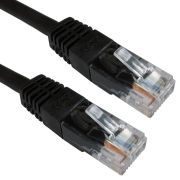 1m Black Cat6 U/UTP Copper Patch Lead
£1.35
2m Black Cat6 U/UTP Copper Patch Lead
£1.95
3m Black Cat6 U/UTP Copper Patch Lead
£2.45
Reviews are shared across closely related product variants, so you can benefit from relevant experience across the range.
I was able to extend my RJ45 Ethernet cable, very good value
Is doing exactly the job it should and arrived right on time.
Be the first to review Cat5e RJ45 Inline Coupler.
Your review will help other customers considering this exact product.
Helpful information gathered across closely related product variants.
Browse RJ45 Inline Couplers helpIt joins two RJ45-terminated cables end to end, giving you one continuous connection where neither cable is long enough on its own.
There is no switch, repeater or protocol conversion hidden inside it; the coupler simply carries the eight contacts from one socket straight through to the other.
No. Plug one terminated RJ45 lead into each side. There is nothing to punch down and nothing to wire.
They will physically connect, but the Cat5e coupler becomes the lower-rated component in the channel.
I would not describe the resulting channel as Cat6 simply because the cables on either side are Cat6.
Use the Cat6 coupler where retaining Cat6 category performance is the requirement.
The RJ45 plugs may connect, but these couplers are unshielded. Do not use one where you need the cable screen to remain electrically continuous through the join.
It does not contain electronics that deliberately set a lower network speed.
It does, however, add another mated connection to the channel, so contact quality and category performance still matter.
One sound, appropriately rated coupler in a healthy channel should not by itself cause a deliberate speed step-down; if the negotiated speed changes after adding it, I would investigate the join.
Not in the sense of a switch or router processing packets. It is passive, so there is no packet queue or electronic forwarding delay hiding in the box.
Its contribution is instead as another electrical connection in the copper channel, where the relevant concerns are signal margin and contact quality.
It joins two RJ45-terminated cables end to end, giving you one continuous connection where neither cable is long enough on its own.
There is no switch, repeater or protocol conversion hidden inside it; the coupler simply carries the eight contacts from one socket straight through to the other.
No. Plug one terminated RJ45 lead into each side. There is nothing to punch down and nothing to wire.
Yes. Both connectors are RJ45 female and use the 8P8C contact format.
The coupler is intended to accept an ordinary male RJ45 plug at each end.
It means eight contact positions are present and all eight are populated. That is the modular connector format commonly referred to as RJ45 for Ethernet.
It means the pins are carried straight across the coupler: pin 1 to pin 1, pin 2 to pin 2 and so on through all eight positions. It does not deliberately cross or rearrange the pairs.
No. An inline coupler extends one connection; it does not turn one Ethernet port into two.
For several devices you need active networking equipment such as a switch rather than a passive coupler.
They will physically connect, but the Cat5e coupler becomes the lower-rated component in the channel.
I would not describe the resulting channel as Cat6 simply because the cables on either side are Cat6.
Use the Cat6 coupler where retaining Cat6 category performance is the requirement.
The RJ45 plugs may connect, but these couplers are unshielded. Do not use one where you need the cable screen to remain electrically continuous through the join.
It does not contain electronics that deliberately set a lower network speed.
It does, however, add another mated connection to the channel, so contact quality and category performance still matter.
One sound, appropriately rated coupler in a healthy channel should not by itself cause a deliberate speed step-down; if the negotiated speed changes after adding it, I would investigate the join.
Not in the sense of a switch or router processing packets. It is passive, so there is no packet queue or electronic forwarding delay hiding in the box.
Its contribution is instead as another electrical connection in the copper channel, where the relevant concerns are signal margin and contact quality.
Cat5e is a normal category for Gigabit Ethernet, so a Cat5e coupler is entirely at home in a correctly constructed Cat5e Gigabit channel.
What the coupler cannot do is rescue poor cable, bad plugs or an overlong run elsewhere in the channel.
Do not assume PoE support merely from the connector fitting. These are passive couplers, but the current catalogue does not give this complete family a specific PoE compliance claim.
The Cat5e and Cat6 versions have 1.5A and 125 VAC component ratings, while the Cat3 model has no equivalent current or voltage ratings populated.
None of that is the same thing as a stated PoE Type 1, 2, 3 or 4 approval.
If the PoE requirement is critical, use a coupler specifically verified for it.
No. The coupler is part of the same copper channel; it does not regenerate the Ethernet signal and does not start a fresh 100 metre allowance.
Cable and connections on both sides still have to be considered as one complete channel.
There is no useful rule that says a whole procession of couplers automatically becomes acceptable.
Every join introduces another pair of mated contacts and consumes some of the channel margin. One necessary join is quite different from constructing an increasingly convoluted chain of short leads and couplers.
Use as few joins as practical, and redesign the run if several are needed.
I would not design it by arithmetic alone. The whole channel includes both cords and the connection between them, and long stranded patch leads can consume more of the signal-loss budget than an equivalent length of normal permanent cabling.
If the run is genuinely that long, treat it as a channel-design job.
Yes. Electrically it is another mated connection between the two ends of the channel. It should be included when considering the finished channel rather than treated as though it were invisible.
No. It joins the wires; it does not regenerate the signal. If you actually need another active Ethernet segment, use appropriate powered networking equipment rather than another passive join.
No. These five products are free-standing inline couplers, not keystone modules.
A keystone aperture expects a body with the appropriate retaining geometry; trying to persuade an ordinary free-standing coupler into the hole merely creates a rather unconvincing piece of sculpture.
Use a keystone-format coupler where panel mounting is required.
No. The standard Cat5e and Cat6 bodies are 48.52 × 24.6 × 25.6mm.
The Cat3 standard coupler is smaller at 36.78 × 22.81 × 16.6mm. The catalogue records those dimensions as definite rather than approximate.
Either way. There is no input side and output side. Push one RJ45 plug into each socket until the plug latches normally.
It is free-standing, but do not make the coupler carry the weight or tension of the cables.
Support the cable nearby, leave a little slack and keep strain off both RJ45 plugs.
That strongly suggests checking conductor continuity and contact quality. Gigabit Ethernet uses all four pairs, whereas a 100Mbps link can operate using only two pairs.
A damaged plug, poor contact, faulty cable or faulty coupler can therefore leave enough working conductors for 100Mbps while preventing Gigabit negotiation.
Start with the join rather than dismantling the rest of the network. Make sure both plugs are fully seated, then test each cable separately if possible and substitute a known-good coupler.
A new connection point gives you three immediate suspects: the first plug, the coupler contacts and the second plug.
No. If moving the joint makes the link come and go, something is making poor contact.
Check the plug latches, try each lead separately and replace the suspect coupler or cable rather than wedging it into a position where it happens to work.
It proves something useful, but not everything. A simple continuity tester can confirm that the eight conductors arrive at the other end in the expected order.
It does not certify insertion loss, return loss, crosstalk or category performance.
Passing continuity is therefore a good first test, not a complete performance certificate.
No meaningful backwards orientation exists. Both ports are female RJ45 and the wiring is straight through, so the coupler is electrically symmetrical for this purpose.
No special network function follows from the housing colour. In this range the colours happen to accompany particular models, but the matters worth paying attention to are category, form factor and shielding.
The electrons have shown remarkably little interest in whether their ABS surroundings are beige or black.