Cat6
Performance
Rated to 250 MHz
Available options
Choose the network category, cable specification and available length.
At a glance
Cat6
Rated to 250 MHz
U/UTP
Cable shielding and construction type.
Solid Copper
Conductor type and material.
LSZH
Outer cable jacket material.
Cca
Construction Products Regulation fire classification.
305m
Supplied cable length.
This British Cables Company four-pair Cat6 U/UTP installation cable is intended for indoor structured cabling where a Cca-classified LSZH cable is specified. It uses solid copper conductors with a green LSZH outer jacket. Supplied in a 305m box, the cable is CPR class Cca and rated to 250 MHz.
The green LSZH/Cca construction provides the Cca option in the British Cables Company range. Purple LSZH/Eca variants cover the Eca option, while black PE/Fca variants are provided for outdoor runs.
Detailed construction, CPR compliance and manufacturer transmission data are provided below for checking against the installation specification.
Designed for fixed cabling between compatible IDC outlets, patch panels and inline couplers.
Four-pair network-cable construction for the fixed link between termination points.
LSZH outer jacket for indoor structured-cabling installations.
Declared classification Cca-s1a,d0,a1; Declaration of Performance BCC1005.
Rated network category and frequency, with detailed manufacturer transmission data provided below.
Supplied length and packaging for planning the permanent cabling run.
Technical data
| Frequency (MHz) | Attenuation (dB/100m) | NEXT min (dB) | PSNEXT min (dB) | ELFEXT min (dB) | PSELFEXT min (dB) | Return loss min (dB) | Skew max (ns/100m) |
|---|---|---|---|---|---|---|---|
| 1 | 2 | 74.3 | 72.3 | 67.8 | 64.8 | 20 | 45 |
| 4 | 3.8 | 65.3 | 63.3 | 55.8 | 52.8 | 23 | 45 |
| 8 | 5.3 | 60.8 | 58.8 | 49.7 | 46.7 | 24.5 | 45 |
| 10 | 6 | 59.3 | 57.3 | 47.8 | 44.8 | 25 | 45 |
| 16 | 7.6 | 56.2 | 54.2 | 43.7 | 40.7 | 25 | 45 |
| 20 | 8.5 | 54.8 | 52.8 | 41.8 | 38.8 | 25 | 45 |
| 25 | 9.5 | 53.3 | 51.3 | 39.8 | 36.8 | 24.3 | 45 |
| 31.25 | 10.7 | 51.9 | 49.9 | 37.9 | 34.9 | 23.6 | 45 |
| 62.5 | 15.4 | 47.4 | 45.4 | 31.9 | 28.9 | 21.5 | 45 |
| 100 | 19.8 | 44.3 | 42.3 | 27.8 | 24.8 | 20.1 | 45 |
| 200 | 29 | 39.8 | 37.8 | 21.8 | 18.8 | 18 | 45 |
| 250 | 32.8 | 38.3 | 36.3 | 19.8 | 16.8 | 17.3 | 45 |
Complete the installation
Compatible products and installation guidance for this installation cable.
Outlet end
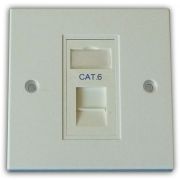
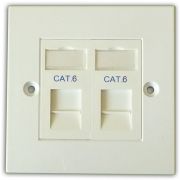
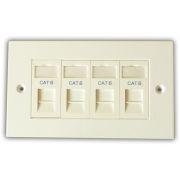
Terminate the room end of the permanent link with matching-category data outlets.
View outlet kitsCabinet end
Terminate the cabinet end of the permanent link on a matching-category patch panel.
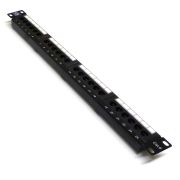 19" 1U 24 Port Cat6 Patch Panel
£30.47
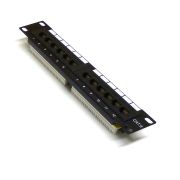 10" 1U 12 Port Cat6 Patch Panel
£24.71
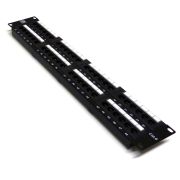 19" 2U 48 Port Cat6 Patch Panel
£41.99
Inline connection
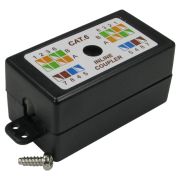
Join or extend matching-category installation cable while retaining punchdown termination.
View network couplersTermination
Use the appropriate impact tool for IDC terminations in the permanent-link installation.
Reviews are shared across closely related product variants, so you can benefit from relevant experience across the range.
Be the first to write a review of this product.
Helpful information gathered across closely related product variants.
Browse Ethernet Installation Cable helpInstallation cable is the fixed part of a structured cabling system: the cable that runs through the building or between fixed termination points, normally ending on an IDC outlet, module or patch panel.
It is not simply a very long patch lead. The idea is to install the solid-conductor cable once, terminate it properly, test it, and then use flexible patch leads at the equipment ends where things are actually moved about.
They are solid annealed copper conductors. The current catalogue does not describe the installation cables in this range as copper-clad aluminium.
Cat5e is entirely capable of Gigabit Ethernet and is still a perfectly serviceable choice where that is the requirement. Cat6 gives you more transmission headroom, is specified to 250MHz rather than 100MHz, and is the more natural choice for a new installation where the small extra cost is acceptable.
Cat6 does not make a 1Gbps Ethernet link run faster than 1Gbps; what you are buying is a higher cabling category and more margin, not a secret second accelerator pedal.
Use one of the LSZH products for an indoor installation where its CPR classification is appropriate to the project. Use the black PE-sheathed products where the cable needs the outdoor-rated construction shown in this range.
Do not choose purely by Cat5e versus Cat6. The transmission category answers one question; the sheath, fire classification and installation environment answer several others.
Normally onto IDC terminals in a compatible patch panel, data module, outlet or punchdown coupler. Keep the cable jacket close to the termination, keep the pair twists intact until close to their contact positions, then punch the conductors down with the correct tool for the hardware.
The current product data specifies a minimum installation bend radius of 8 times the cable outside diameter.
That corresponds to approximately 40mm for the 5.0mm Cat5e cables, 47.2mm for the 5.9mm Cat6 Eca cable and 49.6mm for the 6.2mm Cat6 Cca and external cables. These are installation bend-radius figures, not permission to force the finished cable around a sharp corner once it has been terminated.
Installation cable is the fixed part of a structured cabling system: the cable that runs through the building or between fixed termination points, normally ending on an IDC outlet, module or patch panel.
It is not simply a very long patch lead. The idea is to install the solid-conductor cable once, terminate it properly, test it, and then use flexible patch leads at the equipment ends where things are actually moved about.
They are solid annealed copper conductors. The current catalogue does not describe the installation cables in this range as copper-clad aluminium.
These cables use solid copper conductors, which suit fixed permanent links and IDC termination. Patch leads normally use stranded conductors because they need to flex repeatedly without objecting to being moved behind desks, switches and cabinets.
Solid cable is excellent when it stays where you put it. Asking it to spend its life behaving like a flexible equipment lead rather misses the point of the construction.
U/UTP means the cable has no overall screen and no individual foil or braid around the twisted pairs. It is an unscreened four-pair construction.
That also means there is no cable screen waiting to be bonded to earth. If the job specifically calls for screened cabling because of the electrical environment or system design, choose a screened cabling system rather than trying to turn U/UTP into one after the event.
There are four twisted pairs, giving eight insulated copper conductors in total.
Yes, provided the outlet, module or patch panel is suitable for the cable category and conductor size. This is exactly the sort of cable that is normally punched down onto IDC terminations.
Match Cat5e with suitable Cat5e-or-better hardware and Cat6 with Cat6 hardware if you want the finished link to be a Cat6 installation.
Cat5e is entirely capable of Gigabit Ethernet and is still a perfectly serviceable choice where that is the requirement. Cat6 gives you more transmission headroom, is specified to 250MHz rather than 100MHz, and is the more natural choice for a new installation where the small extra cost is acceptable.
Cat6 does not make a 1Gbps Ethernet link run faster than 1Gbps; what you are buying is a higher cabling category and more margin, not a secret second accelerator pedal.
Use one of the LSZH products for an indoor installation where its CPR classification is appropriate to the project. Use the black PE-sheathed products where the cable needs the outdoor-rated construction shown in this range.
Do not choose purely by Cat5e versus Cat6. The transmission category answers one question; the sheath, fire classification and installation environment answer several others.
Cat6 has the higher cabling performance specification, but Ethernet speed is negotiated by the active equipment and supported by the complete channel. A Cat6 cable between two 1Gbps devices is still a 1Gbps link.
The practical advantage is greater performance headroom and support for applications that place more demanding requirements on the cabling, rather than every packet somehow travelling faster merely because the sheath says Cat6.
The Cat5e products are characterised through 100MHz, while the Cat6 products are characterised through 250MHz. That figure describes the frequency range over which the cabling category has to meet its transmission requirements.
It is not a direct conversion into network data rate. 250MHz is not simply 'two and a half times the Ethernet speed' of 100MHz; frequency and Ethernet throughput are related through the application standard, but they are not interchangeable currencies.
Category 6 can support 10GBASE-T over shorter channels, but it is not the cabling category to specify if the design requirement is 10 Gigabit Ethernet over the full 100m channel distance.
For a new installation that is intended to support 10GBASE-T to 100m, Cat6A is the appropriate design choice. Existing Cat6 links intended for 10GBASE-T at shorter distances should be assessed for the actual channel and alien-crosstalk conditions rather than relying on the word Cat6 alone.
It may be physically possible if the termination hardware accepts the conductor size, but the finished channel is then limited by the lower-category component. Cat6 cable does not promote a Cat5e outlet into Cat6.
If you want a Cat6 permanent link, use Cat6-rated connecting hardware throughout and test the completed link to the required Cat6 limit.
Normally onto IDC terminals in a compatible patch panel, data module, outlet or punchdown coupler. Keep the cable jacket close to the termination, keep the pair twists intact until close to their contact positions, then punch the conductors down with the correct tool for the hardware.
The current product data specifies a minimum installation bend radius of 8 times the cable outside diameter.
That corresponds to approximately 40mm for the 5.0mm Cat5e cables, 47.2mm for the 5.9mm Cat6 Eca cable and 49.6mm for the 6.2mm Cat6 Cca and external cables. These are installation bend-radius figures, not permission to force the finished cable around a sharp corner once it has been terminated.
For ordinary permanent structured cabling, terminate the solid cable onto IDC hardware and use a patch lead from there. That gives you a fixed link designed to stay put and a flexible lead where equipment gets moved.
There are RJ45 plugs made for particular solid conductors, but do not assume that any modular plug is suitable. If you genuinely need a direct plug termination, use a connector specifically specified for the cable construction and conductor size.
The cable itself does not dictate the punchdown tool; the IDC hardware does. Use the tool specified for the patch panel, module, outlet or coupler you are terminating.
For the DCD IDC products that use Krone-style contacts, use the proper Krone-compatible punchdown tool rather than a screwdriver and optimism.
Either scheme can be used with normal four-pair Ethernet cabling. What matters is that a particular run is terminated consistently at both ends.
If one end is T568B, make the other end T568B; likewise for T568A. Consistency also makes later fault-finding considerably less archaeological.
As little as practical. Keep each pair twisted until it is close to its IDC positions, then separate only what you need to dress and punch the conductors down.
Do not comb several centimetres of every pair dead straight because it looks tidy. The twists are part of how the cable controls crosstalk.
Data and mains cabling must be installed with the segregation, containment and electrical-safety provisions required by the applicable installation standards and the particular environment. A single universal separation distance cannot be stated for every installation because the required arrangement depends on factors including containment, barriers, circuit type and cable construction.
Where power and telecommunications routes interact, follow the project design and the applicable requirements of BS 7671, BS 6701 and the relevant BS EN 50174 installation standards.
No. Use a sensible route and pull it without stretching, kinking or crushing it. If it needs heroic force to get round a bend, fix the route rather than declaring war on the cable.
The finished cable still has to meet its electrical performance. A sheath that looks intact is not proof that an abused twisted-pair cable is still a good link.
Use cable fixings that hold it securely without crushing or sharply deforming the sheath. Do not drive tight staples across the cable.
Twisted-pair geometry matters. A fixing should support the run, not flatten it into a new and untested cable design.
Yes. At the very least, check the completed run for correct wiremap and obvious faults. If the installation is being delivered as a standards-compliant Cat5e or Cat6 system, certify the permanent link with a suitable field tester to the required category.
A link light only proves that the equipment has managed to establish a link. It is not a Cat6 certificate.
No. The box quantity tells you how much cable you bought; it does not rewrite the Ethernet cabling standards.
For conventional balanced-copper structured cabling, the familiar design limit is up to 90m for the permanent link and 100m for the complete channel including patch cords. A 305m box is enough raw cable for several runs, not one heroic run from one end of a building to another.
Yes, standards-based PoE can be carried over appropriate balanced copper structured cabling. The current Cat6 products in this range are explicitly listed by the supplier for PoE, and the use of solid copper conductors is appropriate for fixed remote-powering links.
For higher-power PoE, large cable bundles or demanding ambient conditions, the installation still has to be designed to the applicable remote-powering and temperature guidance. 'PoE capable' is not an instruction to ignore bundle heating.
The permanent link is the fixed installed cabling, normally from the patch-panel termination to the work-area outlet or another fixed termination, and is designed for a maximum of 90m.
The channel includes that fixed link plus the equipment and patch cords used at the ends. The conventional maximum channel length is 100m. Those figures are design limits; tester allowances for measurement uncertainty must not be treated as additional installation length.
A sensible service loop is useful. Leave enough spare to reterminate or reposition the end without having to replace the whole run, but do not leave huge coils simply because cable was left in the box.
Dress the spare so it keeps its bend radius, stays out of the way and can actually be reached later. Spare cable that has been crushed behind a cabinet is not much of a favour to the next installer.
PoE sends DC current through the same balanced pairs used for data, so conductor resistance and the resulting heat matter as well as the data specification. Solid copper conductors provide predictable electrical performance for the fixed cabling system.
That is one reason not to confuse these products with copper-clad aluminium cable. Similar-looking boxes can conceal very different conductors, and electricity remains stubbornly unimpressed by marketing adjectives.
No. The active devices still determine the Ethernet speed they can negotiate, and every component in the channel has to support the application.
Higher-category cabling can provide the transmission performance needed for faster applications and more margin, but a Cat6 cable does not turn a 100Mbps switch into a Gigabit switch any more than a wider driveway changes the engine in the car.
Yes. The current manufacturer application data lists analogue and digital video applications as supported uses for these products, subject to the requirements of the particular video system and its interface equipment.
Not in the sense of a hosepipe simply delivering less and less speed with every extra metre. Ethernet equipment negotiates a link rate, while the cabling has to keep attenuation, crosstalk, delay and the other transmission parameters within the limits needed for that application.
Longer cable does increase loss and reduces the available margin. Push the channel beyond what the application and cabling can support and you may get errors, instability or a lower negotiated speed rather than a neat percentage reduction for every metre.
No. In these product names, Cca is the CPR reaction-to-fire Euroclass. The conductors are solid annealed copper.
Copper-clad aluminium is commonly abbreviated CCA in cabling discussions, which is precisely why this can be confusing: one small change in context leaves three familiar letters doing two entirely different jobs. Here, Cca is the fire class, not the conductor material.
The current LSZH products are specified for indoor installation. They should not be represented as outdoor-rated merely because an indoor cable can physically be routed outside.
Use the black PE external product where the cable route requires the outdoor construction specified in this range.
LSZH means Low Smoke Zero Halogen. In this range it describes the sheath used on the indoor cable products and is intended to reduce smoke and corrosive halogen gas compared with conventional halogen-containing sheath materials when the cable is exposed to fire.
LSZH is a material/fire-behaviour description; it does not by itself tell you the cable's complete CPR reaction-to-fire class. That is why the violet Eca and green Cca cables can both be LSZH while carrying different CPR classifications.
Eca and Cca are different CPR reaction-to-fire classifications. The violet indoor products in the current range are Eca, while the green indoor products are Cca with additional smoke, droplet and acidity classifications.
The Cca products provide the higher reaction-to-fire classification. Cable selection must follow the requirements of the building, project specification and applicable cabling standards rather than being based on sheath colour alone.
The current Cat5e green LSZH product is classified Cca-s1a,d1,a1. The current Cat6 green LSZH product is classified Cca-s1a,d0,a1.
Both exceed the Cca-s1b,d2,a2 minimum cited by British Cables Company for telecommunications installations where BS 6701:2016+A1:2017 applies.
The Cat6 products use a polyethylene cross member to help maintain the geometry and separation of the four twisted pairs, which assists crosstalk performance.
It is not decorative packing. Trim only what you need at the termination and avoid dismantling half the cable in pursuit of a prettier fan-out.
The Cat5e products are approximately 5.0mm overall diameter with a ±0.2mm tolerance. The Cat6 Eca LSZH cable is approximately 5.9mm ±0.2mm. The Cat6 Cca LSZH and Cat6 external PE cables are approximately 6.2mm ±0.3mm.
Allow for the actual cable diameter when choosing modules, glands, conduit and trunking, and remember that a bundle of twenty cables is not simply one cable multiplied by twenty in a perfectly obedient straight line.
Not universally. In this particular range, violet identifies the indoor LSZH Eca products, green identifies the indoor LSZH Cca products, and black identifies the external PE Fca products.
That is useful shorthand when looking at these products, but jacket colour is not a standards oracle. With another manufacturer or installation, read the actual category, sheath and CPR markings rather than trying to divine the specification from the colour alone.
It helps open the outer sheath when preparing the cable for termination. Use it to start a controlled slit in the jacket, then trim it away once the cable is prepared.
It is not a pulling cord or a strain member. Do not hang the cable's installation load from it.